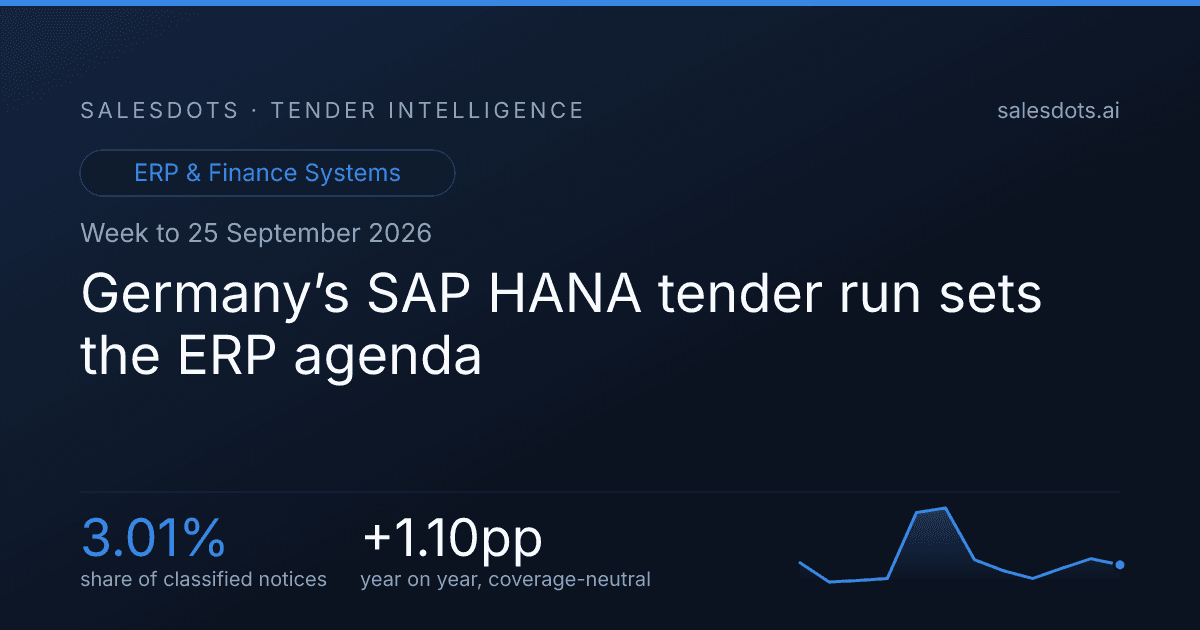
Germany’s SAP HANA tender run sets the ERP agenda
Five repeat SAP HANA notices from Germany’s federal interior procurement authority put delivery capacity and differentiation at the centre of this ERP buying window.
Germany’s federal interior-ministry procurement authority appears five times among repeat buyers for SAP HANA services. Its largest listed tender is valued at €34 million, with further notices carrying €25 million, €17 million and €13 million values. The notice titles identify services in the SAP HANA environment, although the available context does not establish the programme behind them.
That concentrated buying sits inside a 4.73-day window containing 86 ERP and finance notices from 77 buyers in 22 countries. It is a signal to account teams that the immediate contest is not simply for new ERP logos: a named federal buyer is repeatedly taking SAP-centred services to market.
Where this market is going
ERP and finance systems account for 3.01% of the classified notice corpus, a coverage-neutral rise of 1.1 percentage points. The monthly shape is lumpy rather than steady. Share moved from 2.07% in September 2025 to 1.69% in October, then edged through 1.72% in November and 1.76% in December before jumping to 3.06% in January 2026 and 3.15% in February. It then fell to 2.13% in March, 1.91% in April and 1.76% in May, before recovering to 1.96% in June and 2.15% in July, then easing to 2.03% in August.
The present 3.01% share is therefore a renewed spike after a volatile year, not evidence of a smooth expansion. Bid teams should treat the current window as a prompt to qualify active accounts quickly, while using the buyer and country pattern to decide where specialist delivery teams are worth deploying.
ERP & Finance Systems: share of all classified public IT tenders
Share, not volume. Monthly, last 12 complete months.
Where the tenders were published
Notices by buyer country, 4.73 days to 2026-09-25.
How hard the competition is
Competition is split sharply by country. Germany records an average of 253.3 bids, against 1 in Poland, 2 in Sweden and 4 in Belgium. In Germany, a supplier needs technical differentiation, credible SAP delivery depth and a proposal that can survive a crowded field. In Poland and Sweden, the opposite applies: with thin bid counts, qualification, eligible delivery capacity and willingness to pursue the opportunity are likely to constrain the field more than price alone.
The blended average is 58.4 bids across 18 measured cases, but it conceals that country divide. SMEs account for 99% of measured bids, making them the main competitive presence in this work, while 39% of cases are single-bid. That combination means the practical winner is often the bidder that can meet the buyer’s eligibility and delivery test, rather than the bidder that merely discounts hardest.
How these contracts are awarded
Stated award criterion, for the tenders that declared one.
What is driving it
No regulation is cited directly in this ERP and finance notice set. The wider regulation tracker is nonetheless moving: Poland’s uKSC records 288 tenders in the latest 30 days against 212 in the preceding 30 days; DPM 2.0 records 2 against 0; NIS2 records 2 against 4; CBAM records 1 against 0; and DORA records 0 against 1. These are useful account signals, not proof that each framework is driving an ERP purchase.
The nearer finance-system triggers are the Solvency II Review and the Bank Account Registries and BARIS regime. The Solvency II Review requires insurers and supervisors to adapt reporting and risk frameworks, with transposition by 29 January 2027 and application from 30 January 2027. Bank-account registry rules require central automated mechanisms for account, securities, crypto-asset and safe-deposit information, with interconnection through BARIS by 10 July 2029; the extended national scope applies from 10 July 2027. Both are product-procurement and compliance-work triggers: they create demand for data, reporting, controls and integration, while also imposing regulatory change obligations. The EU AML Package also applies from 10 July 2027, adding a related data-flow and supervisory-change prospect set.
Regulations named in live tenders
Tenders citing each framework, last 30 days.
The calendar ahead
| Date | Framework | Milestone | Where |
|---|---|---|---|
| 2027-01-29 | Solvency II Review (Directive 2025/2) | transposition deadline | EU |
| 2027-01-30 | Solvency II Review (Directive 2025/2) | applies from | EU |
| 2027-07-10 | Bank Account Registries + BARIS (AMLD6 2024/1640 art. 16) | applies from | EU |
| 2027-07-10 | EU AML Package (AMLR 2024/1624 + AMLA 2024/1620) | applies from | EU |
What shifted this week
Demand by type of work, against its own 12-week average
Percentage difference from the same vertical’s recent baseline.
Whose technology is being named
SAP is the only named vendor with a reported movement: 29 notices across 14 countries, 121% above its 12-week average of 13.1. Microsoft appears in 4 notices across 4 countries, against a 12-week average of 1.7, but no delta is reported. IBM Cloud appears in 1 notice in 1 country, against a 12-week average of 0.1, also without a reported delta. There is no reported negative vendor delta in this list, so the data does not identify a named-vendor displacement story yet. SAP’s 121% increase is the opening for rivals able to compete around migration, implementation, integration and managed services rather than attempting a generic platform challenge.
The federal buyer’s five repeat SAP HANA notices show where that contest is happening, including the €34 million tender for services in the SAP HANA environment. The offering mix supports a delivery-led reading: custom development has 38 notices and is 120% above its 12-week average; system implementation has 13 notices and is 79% above; support and maintenance has 13 and is 59% above; licences and SaaS has 12 and is 163% above. The immediate opportunity is broad enough for software, implementation and support suppliers, but the repeat HANA buyer makes SAP ecosystem capability the clearest route into the largest named work.
Vendors named in this window’s tenders
Notices naming each vendor, with movement against the same vertical’s 12-week average.
Who is buying repeatedly
| Tenders | Buyer | Country | Example |
|---|---|---|---|
| 5 | Bundesrepublik Deutschland, vertreten durch das Bundesministerium des Innern, vertreten durch das Beschaffungs | DE | Germany – IT services: consulting, software development, Internet and support – Dienstleistungen im SAP-Umfeld |
| 2 | Consorcio de Compensación de Seguros | ES | Spain – Financial analysis and accounting software package – Suscripción y mantenimiento de licencias del sist |
| 2 | Valsts sabiedrība ar ierobežotu atbildību "Latvijas Sabiedriskais medijs" | LV | Latvia – Software programming and consultancy services – Uzņēmuma resursu pārvaldības (ERP) sistēmas ieviešana |
| 2 | Zakład Ubezpieczeń Społecznych | PL | Poland – Software implementation services – Zakup migracji Systemu Wspomagania Ekonomiki Zakładu (SWEZ) do now |
| 2 | Växjö kommun | SE | Sweden – Time accounting or human resources software package – HR-/Lönesystem |
| 2 | Správa železnic, státní organizace | CZ | Czechia – Software implementation services – Re-implementace systému SAP ECC 6.0 na SAP S/4HANA |
An organisation running several tenders in one window is usually working through a programme rather than buying once.
The biggest tenders
The five largest published euro values are concentrated in two buyers. Bundesrepublik Deutschland, represented by the Federal Ministry of the Interior procurement authority, accounts for the €34 million, €25 million, €17 million and €13 million SAP HANA service tenders; the available context does not establish the underlying programme. Monetra Pohjois-Savo Oy accounts for a €27.6 million payroll-system procurement for wellbeing areas, though no external programme detail is established. The €158,116,656.25 total covers only the 34 notices that published a value in EUR, not the size of the ERP and finance market.
Values as published by the buyer, for the 34 of 86 tenders in this window that stated one in EUR.
Deadlines worth watching
Who won
Suppliers with the most awards this window
Awards published in the window, by named winner.
Sources consulted
Pages the writer read for context while drafting this column. The figures above come from the notices, not from these.
The next bids should be built around named delivery evidence: SAP HANA capability for the German federal run, and reporting, data and integration propositions for finance authorities approaching regulatory change.
Method
Built from 86 public procurement notices published between 2026-09-20 and 2026-09-25, classified into the ERP & Finance Systems vertical. Every figure on this page is computed from those notices; the commentary is written around them. Sources: ted, prozorro. Tenders featured in earlier editions of this column are excluded from the named lists above.
Frequently Asked Questions
What is the current ERP and finance tender share?
ERP and finance systems represent 3.01% of the classified corpus, up 1.1 percentage points.
Which countries show the sharpest competition contrast?
Germany averages 253.3 bids, compared with 1 in Poland, 2 in Sweden and 4 in Belgium.
What do the published values cover?
34 notices published a value in EUR, totalling €158,116,656.25, with a median of €2,017,050.