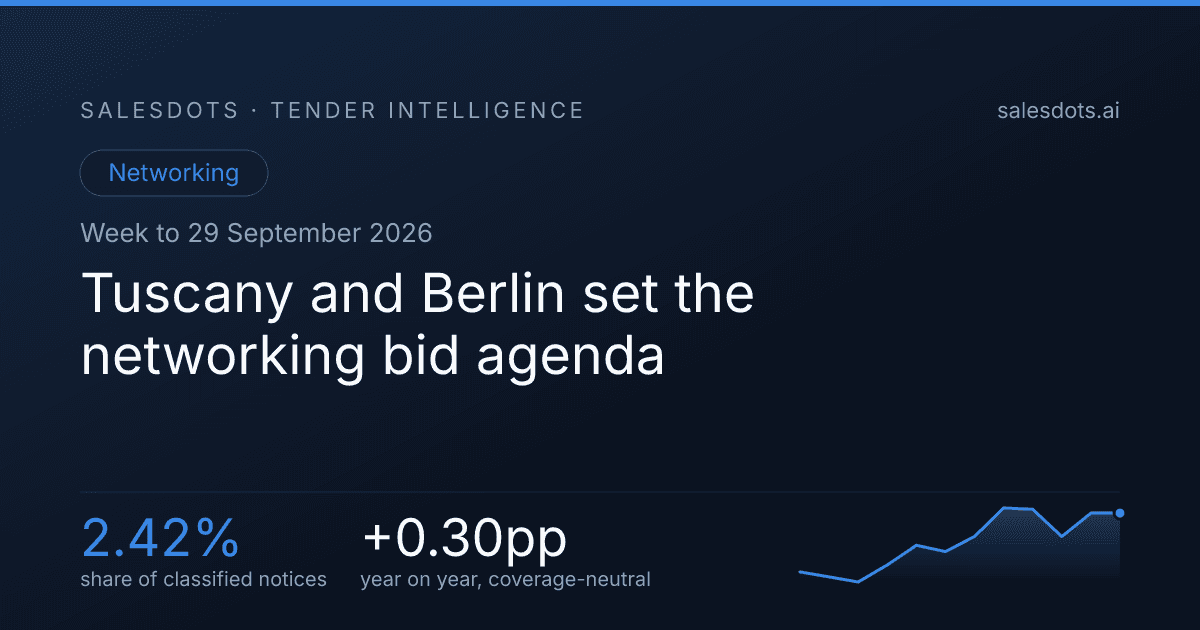
Tuscany and Berlin set the networking bid agenda
Regione Toscana and ITDZ Berlin account for the largest named opportunities, while Germany’s relatively deeper field demands a different bid plan from Poland and Italy.
Regione Toscana has put a €28.1m framework for network and security products, hardware, software and maintenance into play. This is not a routine equipment purchase: it sits alongside the region’s shared digital infrastructure and its SPC-RTRT4 connectivity framework, making it a route into a buyer with an established regional-networking role.
IT-Dienstleistungszentrum Berlin follows with a €19.7m framework for BeLa MSN 2026. ITDZ operates and expands Berlin’s state network, so the tender places suppliers in a public-administration backbone environment rather than a standalone site deployment. Those two named frameworks should shape account plans before bidders spend time treating the week’s 72 notices as a homogeneous pipeline.
Where this market is going
Networking’s coverage-neutral share is 2.42%, up 0.3 points. The monthly pattern is lumpy rather than steady: share moved from 1.88% in September 2025 to 1.80% in October and 1.72% in November, then recovered to 1.99% in December and 2.30% in January 2026. It eased to 2.20% in February before reaching 2.44% in March and 2.89% in April.
The next phase was equally uneven. Share was 2.87% in May, fell to 2.44% in June, then returned to 2.81% in July and held at 2.81% in August. That pattern argues against staffing a permanent surge team on the basis of the current week alone; it does support disciplined pursuit around identifiable frameworks and repeat buyers.
Networking: share of all classified public IT tenders
Share, not volume. Monthly, last 12 complete months.
Where the tenders were published
Notices by buyer country, 7 days to 2026-09-29.
How hard the competition is
Germany is the relatively crowded market in the measured awards, with 2.5 average bids, against 2 in Poland and 2 in Italy. In Germany, technical differentiation, credible architecture and delivery evidence should decide the bid more than a price-led response. In Poland and Italy, where the field is thinner, qualification, local delivery capacity and an executable implementation plan are the constraint, not price alone.
The competition sample is measured on 16 cases. SMEs account for 58% of the measured bid pattern, while 38% are single-bid outcomes. That is a warning against assuming that low average bid counts mean an easy incumbent displacement: the practical task is often to clear eligibility and capacity hurdles before the commercial contest begins. Akademia Pożarnicza has 2 tenders, including a next-generation firewall deployment; Urząd Komunikacji Elektronicznej has 2 tenders for configured mobile-network signal measurement equipment; and Військова частина А1214 has 2 tenders, including Ubiquiti network equipment.
How these contracts are awarded
Stated award criterion, for the tenders that declared one.
What is driving it
The strongest citation momentum is Poland’s Ustawa o krajowym systemie cyberbezpieczeństwa, with 281 tenders in the last 30 days against 219 in the preceding 30 days. NIS2 is unchanged at 3 against 3. DPM 2.0 has 2 against 0, CBAM has 1 against 0, and DORA has 0 against 1. For networking suppliers, the uKSC movement is the immediate demand signal; the other changes are too small to treat as a volume trend, but are useful account-targeting prompts in regulated sectors.
The compliance calendar is more consequential than the recent citation counts. The Solvency II Review requires insurance supervisors and insurers to adapt reporting and risk frameworks, with transposition due on 29 January 2027 and application from 30 January 2027. AMLD6 requires automated mechanisms to identify holders or controllers of specified accounts and safe-deposit boxes; national registry scope applies from 10 July 2027 and BARIS is to connect national mechanisms by 10 July 2029. The EU AML Package also applies from 10 July 2027, with AMLA direct supervision from 1 January 2028. This is both compliance work and product procurement: the immediate spend is likely to centre on data flows, secure connectivity, access controls and integration, before it becomes a straightforward hardware refresh.
Regulations named in live tenders
Tenders citing each framework, last 30 days.
The calendar ahead
| Date | Framework | Milestone | Where |
|---|---|---|---|
| 2027-01-29 | Solvency II Review (Directive 2025/2) | transposition deadline | EU |
| 2027-01-30 | Solvency II Review (Directive 2025/2) | applies from | EU |
| 2027-07-10 | Bank Account Registries + BARIS (AMLD6 2024/1640 art. 16) | applies from | EU |
| 2027-07-10 | EU AML Package (AMLR 2024/1624 + AMLA 2024/1620) | applies from | EU |
What shifted this week
Demand by type of work, against its own 12-week average
Percentage difference from the same vertical’s recent baseline.
Whose technology is being named
Cisco appears in 5 notices across 4 countries, but is 30% below its 12-week weekly average of 7.2. Starlink appears in 2 notices in 1 country and is down 11% against its 12-week average of 2.2. Those falls are the more useful signal: they create room to test whether requirements are being rewritten around alternatives, service models or buyer-specific qualification rather than assuming vendor mention equals a durable position.
F5 appears in 3 notices across 2 countries, against a 12-week weekly average of 0.5; no percentage delta is supplied. Fortinet appears in 1 notice in 1 country, against a 12-week weekly average of 0.9; again, no percentage delta is supplied. The named-vendor data does not associate any of Cisco, F5, Starlink or Fortinet with the Regione Toscana or ITDZ Berlin tenders, so bidders should not infer a vendor position in either of the largest opportunities from this dataset. The live competitive question is therefore whether the Cisco and Starlink declines translate into specification openings in the next notices.
Vendors named in this window’s tenders
Notices naming each vendor, with movement against the same vertical’s 12-week average.
Who is buying repeatedly
| Tenders | Buyer | Country | Example |
|---|---|---|---|
| 2 | Akademia Pożarnicza | PL | Poland – Network equipment – Dostawa i wdrożenie urządzeń brzegowych typu Next Generation Firewall niezbędne d |
| 2 | Військова частина А1214 | UA | Мережеве обладнання Ubiquiti (засоби зв’язку) |
| 2 | Urząd Komunikacji Elektronicznej | PL | Dostawa skonfigurowanego zestawu pomiarowego sygnałów sieci telefonii komórkowych |
An organisation running several tenders in one window is usually working through a programme rather than buying once.
The biggest tenders
The reported €57.2m total and €3.7m median cover only the 27 notices that published a value in euros, not the size of the networking market. Within that subset, Regione Toscana’s €28.1m framework is the largest, followed by ITDZ Berlin’s €19.7m BeLa MSN 2026 framework. Toscana is buying into its regional shared-connectivity estate, while ITDZ’s requirement aligns with its operation and expansion of the Berlin state network. The remaining largest named opportunities are the Slovak interior ministry’s €4.5m structured-cabling renewal framework, Gemeinde Marklkofen’s €2.9m Gigabit-RL 2.0 service-concession procedure, and ANAS S.P.A.’s €2m data-transmission services for Lombardia tunnel installations.
Values as published by the buyer, for the 27 of 72 tenders in this window that stated one in EUR.
Deadlines worth watching
Who won
Suppliers with the most awards this window
Awards published in the window, by named winner.
Sources consulted
Pages the writer read for context while drafting this column. The figures above come from the notices, not from these.
Watch whether the next notices convert the uKSC citation rise into named network-security requirements, and whether Cisco’s decline persists while the Toscana and Berlin frameworks move from market access to supplier selection.
Method
Built from 72 public procurement notices published between 2026-09-22 and 2026-09-29, classified into the Networking vertical. Every figure on this page is computed from those notices; the commentary is written around them. Sources: bzp, doe, ted, prozorro. Tenders featured in earlier editions of this column are excluded from the named lists above.
Frequently Asked Questions
What is networking’s current coverage-neutral procurement share?
Networking’s share is 2.42%, up 0.3 points.
Which named tender has the highest published value?
Regione Toscana’s network and security framework is valued at €28,065,015.
Where is measured bid competition highest?
Germany averages 2.5 bids, compared with 2 in Poland and 2 in Italy.