DG BUDG's €270m framework sharpens the ERP contest
A DG BUDG framework leads a lumpy ERP buying upswing, while bid pressure ranges from six bidders in Belgium to one in Poland.
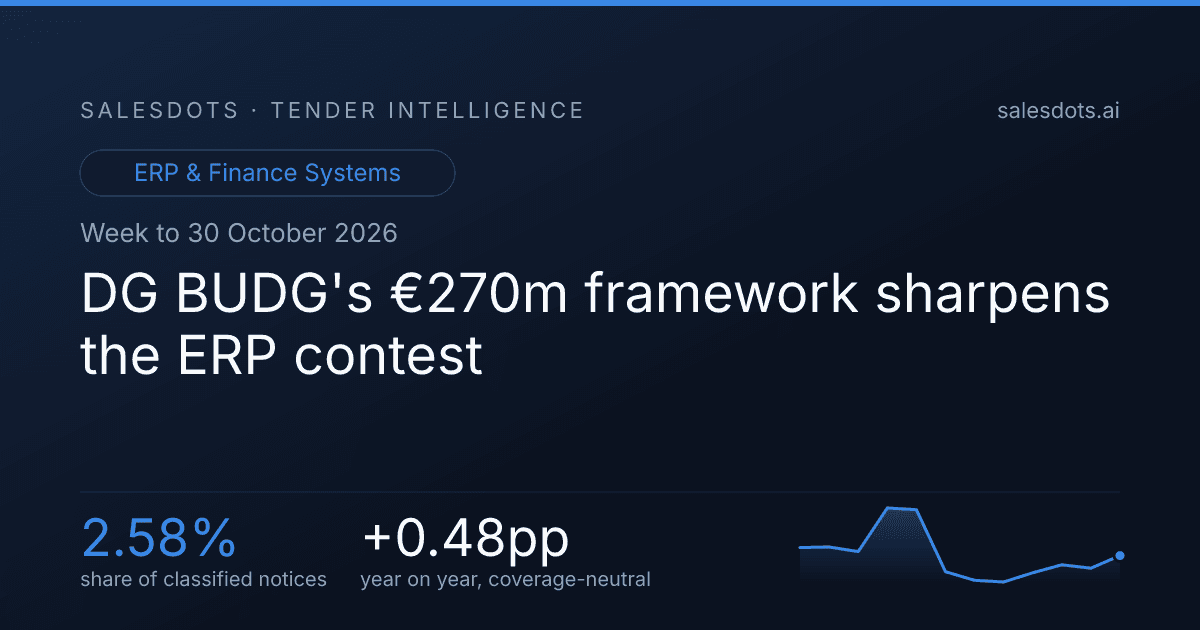
European Commission, DG BUDG - Budget has issued a €270m framework, the largest tender in this week's ERP and finance systems notices. DG BUDG's remit includes the financial IT estate behind the Commission's SUMMA programme, which is replacing ABAC for budget implementation, accounting and treasury. This is a procurement to qualify for early, not a routine application-support opportunity.
The wider mix points in the same direction. System implementation appears in 50 notices, 128% above its 12-week average; support and maintenance is at 30, up 53%; licences and SaaS at 17, up 47%; and managed services at 10, up 60%. Custom development, by contrast, is at 18, down 21%, while body leasing is at 1, down 67%.
Where this market is going
ERP and finance systems now account for 2.58% of classified notices, a coverage-neutral rise of 0.48 percentage points. The monthly pattern is lumpy rather than steady: share moved from 2.43% in October 2025 to 2.44% in November and 2.36% in December, then rose to 3.12% in January 2026 and 3.09% in February. It then fell to 2.01% in March, 1.86% in April and 1.83% in May before recovering through 1.99% in June, 2.13% in July, 2.07% in August and 2.29% in September.
The current 2.58% reading therefore looks like a recovery from a spring trough, not a straight-line expansion. Bid teams should treat implementation, support and licensing as the live combination, and avoid reading raw notice counts as market growth because collection coverage changes between periods.
ERP & Finance Systems: share of all classified public IT tenders
Share, not volume. Monthly, last 12 complete months.
Where the tenders were published
Notices by buyer country, 7 days to 2026-10-30.
How hard the competition is
The commercial reality differs sharply by country. Belgium averages 6 bids and Finland 5, while Germany averages 3: in those markets, technical differentiation, credible migration methods and quality evidence will decide contests more often than a price-only posture. Belgium's 6 notices and Finland's 9 make those high-bid environments material enough to warrant serious bid investment.
Poland averages 1 bid, Czechia 1.2 and Spain 1.7. In these thinner fields, the constraint is likely to be qualification, local delivery capacity and willingness to take operational responsibility, not price alone. The competition sample covers 27 notices, with 52% single-bid outcomes and an SME bid share of 69%; SMEs are taking a substantial share of this work, so incumbency is not the only route to award.
How these contracts are awarded
Stated award criterion, for the tenders that declared one.
What is driving it
The 30-day citation movement is mixed. KSeF mandatory e-invoicing has 4 tenders, from 2 in the preceding 30 days; NIS2 has 4, from 3; BSI IT-Grundschutz has 3, from 1; and e-Doręczenia has 2, from 1. eIDAS 2 is the exception, with 4 tenders against 11 in the preceding 30 days. These are compliance references, not proof of demand on their own, but KSeF and e-Doręczenia are especially likely to turn into finance-workflow, document-routing and integration procurement alongside compliance services.
The nearer structural triggers are Solvency II Review, European Health Data Space and Bank Account Registries + BARIS. Solvency II Review requires insurers and supervisors to adapt reporting and risk frameworks, with transposition by 29 January 2027 and application from 30 January 2027. EHDS creates common rules and infrastructure for electronic health data and applies from 26 March 2027. Bank Account Registries + BARIS applies from 10 July 2027. For suppliers, this is both product procurement and compliance work: reporting models, access controls, data exchange and auditability will need delivery capacity as well as software.
Regulations named in live tenders
Tenders citing each framework, last 30 days.
The calendar ahead
| Date | Framework | Milestone | Where |
|---|---|---|---|
| 2027-01-29 | Solvency II Review (Directive 2025/2) | transposition deadline | EU |
| 2027-01-30 | Solvency II Review (Directive 2025/2) | applies from | EU |
| 2027-03-26 | European Health Data Space (Regulation 2025/327) | applies from | EU |
| 2027-07-10 | Bank Account Registries + BARIS (AMLD6 2024/1640 art. 16) | applies from | EU |
| 2027-07-10 | Bank Account Registries + BARIS (AMLD6 2024/1640 art. 16) | transposition deadline | EU |
| 2027-07-10 | EU AML Package (AMLR 2024/1624 + AMLA 2024/1620) | applies from | EU |
What shifted this week
Demand by type of work, against its own 12-week average
Percentage difference from the same vertical’s recent baseline.
Whose technology is being named
SAP is named in 27 notices across 15 countries, up 31% against its 12-week average. Microsoft appears in 7 notices, up 83%. Cegid, UKG, Visma, Oracle and Konica Minolta each appear in 1 notice, with no delta reported for those vendors. The more useful displacement signal is Oracle: its 1 notice sits against a 12-week average of 1.6, even though the data does not publish a delta for it.
SAP's movement is visible in named buying rather than merely in keyword counts. Železničná spoločnosť Slovensko, a.s. has an €8.13m tender for SAP software support and new licences, while HEP d.d. appears twice in the repeat-buyer data for SAP distribution-system maintenance, with a largest published value of €2m. That gives SAP partners a concrete support-and-licensing lane to pursue; Oracle partners should test whether apparent underrepresentation reflects displacement or simply a narrow notice week before treating it as a broad market shift.
Vendors named in this window’s tenders
Notices naming each vendor, with movement against the same vertical’s 12-week average.
Who is buying repeatedly
| Tenders | Buyer | Country | Example |
|---|---|---|---|
| 2 | Kokkolan Energia Oy | FI | Finland – IT services: consulting, software development, Internet and support – KESKEYTYSILMOITUS Talouden tie |
| 2 | Comisión ejecutiva del Consejo de Administración de la Empresa Municipal de Transportes de Fuenlabrada, S.A. | ES | Spain – Software implementation services – Suministro y servicios de evolución e implementación de los sistema |
| 2 | Miejskie Centrum Obsługi Oświaty w Krakowie | PL | Dostawa licencji na oprogramowanie do elektronicznego obiegu dokumentów finansowo-księgowych oraz kadrowo-płac |
| 2 | HEP d.d. | HR | Croatia – System maintenance services – Nadogradnja i održavanje SAP sustava za distribucijsku djelatnost |
| 2 | TECHNOLOGY INNOVATION s.r.o. | CZ | Czechia – Custom software development services – Vytvoření platformy pro správu účetních dokladů pro společnos |
An organisation running several tenders in one window is usually working through a programme rather than buying once.
The biggest tenders
The published values cover only the 44 notices that disclosed a value in euros, not the size of the market. After DG BUDG's €270m framework, the largest named opportunities are Българска народна банка at €8.16m for its currency-reserve management system, Železničná spoločnosť Slovensko at €8.13m for SAP support and licences, Espoon kaupunki at €8m for HR and payroll systems, and Kamer van Koophandel at €7.8m for an ERP system. DG BUDG is the clear strategic account because of SUMMA; the Bulgarian National Bank's wider procurement estate also includes SAP core-banking support and functional development. Espoo's finance estate has moved to Oracle Cloud ERP and EPM, making its HR and payroll buy a useful signal for suppliers able to work alongside an established cloud finance platform.
Values as published by the buyer, for the 44 of 103 tenders in this window that stated one in EUR.
Deadlines worth watching
Who won
Suppliers with the most awards this window
Awards published in the window, by named winner.
Sources consulted
Pages the writer read for context while drafting this column. The figures above come from the notices, not from these.
With 57 notices still open to deadline, pursue the DG BUDG-scale implementation and framework route with a qualification-led team, but keep a separate, capacity-led play for Poland, Czechia and Spain where thin competition can reward suppliers prepared to own delivery.
Method
Built from 103 public procurement notices published between 2026-10-23 and 2026-10-30, classified into the ERP & Finance Systems vertical. Every figure on this page is computed from those notices; the commentary is written around them. Sources: bzp, ted, cvpis_lt, prozorro, sicap_ro. Tenders featured in earlier editions of this column are excluded from the named lists above.
Frequently Asked Questions
What is the current direction of ERP and finance procurement?
ERP and finance systems represent 2.58% of classified notices, up 0.48 percentage points on the coverage-neutral measure.
Where is ERP competition most and least crowded?
Belgium averages 6 bids and Finland 5, while Poland averages 1, Czechia 1.2 and Spain 1.7.
What does the published tender value cover?
€323113860.89 covers 44 notices that published a value in EUR, out of 103 notices.