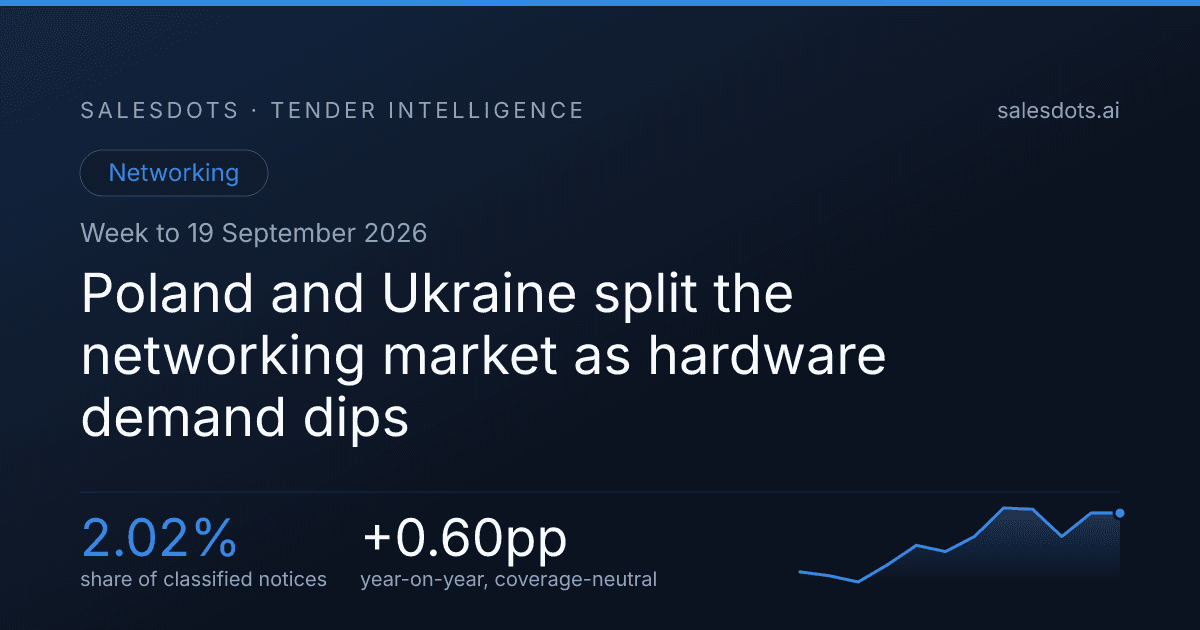
Poland and Ukraine split the networking market as hardware demand dips
32 percent each for Poland and Ukraine, Cisco down 48 percent on its 12-week average, and connectivity tenders almost vanishing. Here is what the week's 66 notices mean for your next bid.
Narodowy Bank Polski went to market to modernise its F5 SSL Orchestrator traffic decryption system, which is about as specific a technical requirement as a networking tender gets. The Polish central bank appeared twice in this week's notices, alongside Prokuratura Okręgowa w Rzeszów, also with two tenders covering network switch installations into prosecutor's office server rooms. That concentration of Polish public-sector activity is not incidental: Poland accounted for 32 percent of the 66 networking notices published in the seven days to 19 September 2026, matching Ukraine's 32 percent share exactly, with Germany a distant third at 11 percent.
Poland's 21 notices came with 8 published awards and an average of 1.3 bids per procedure, which is the number that should concern anyone selling into Warsaw right now. At 1.3, you are frequently the only serious contender in the room, but that cuts both ways: buyers with no competitive pressure have little incentive to move quickly or pay a premium, and a single-bid result on a sensitive public-sector contract can attract scrutiny that delays payment. Ukraine's 21 notices produced no published awards and no bid-count data, which reflects the procurement environment rather than a lack of activity. Italy, with only 2 notices, recorded an average of 4 bids per procedure, the highest in the dataset, suggesting that when Italian public bodies do go to market for networking, they attract genuine competition.
Where this market is going
Networking's share of the classified procurement corpus now stands at 2.02 percent, up 0.6 points on the same period a year ago. The monthly trend tells a more textured story: share fell from 2.89 percent in April 2026 to 2.44 percent in June, recovered to 2.81 percent in both July and August, and the current week sits at 2.02 percent, which is below the recent plateau. That dip is worth watching but not panicking about; the April and May peaks were unusually high relative to the preceding months, and the underlying direction since September 2025, when share was 1.88 percent, has been upward.
What has shifted more sharply this week is the composition of demand. Every offering category is running below its 12-week weekly average. Hardware supply, always the dominant category in networking tenders, accounts for 42 percent of notices this week against a 12-week weekly average of 52.1 percent. System implementation is at 10 percent of notices against a weekly average of 14.3 percent. Connectivity and telecoms tenders have almost disappeared, at 1 percent of notices against a weekly average of 5 percent. Whether this is a seasonal trough or a genuine shift away from pure connectivity procurement is not yet clear from a single week's data, but a supplier whose pipeline is weighted towards fibre and WAN contracts should note that HOWOGE Wohnungsbaugesellschaft, the Berlin social housing company, appeared twice this week with fibre rollout and signal delivery work, making it one of the few active connectivity buyers in the dataset.
Networking: share of all classified public IT tenders
Share, not volume. Monthly, last 12 complete months.
Where the tenders were published
Notices by buyer country, 7.06 days to 2026-09-19.
How hard the competition is
The average across the 11 procedures where bids were measured was 2.3, and 36 percent of tenders attracted only one bid. That single-bid rate is high enough to mean that in more than a third of these procurements, whoever submitted a compliant response won. For a supplier with the right product certifications and the capacity to respond quickly, that is an opportunity to set price without reference to a competitor. For a buyer reading the same statistic, it is an argument for running longer notice periods or publishing prior information notices to widen the field.
SMEs accounted for 79 percent of bids measured, which is consistent with a market where the dominant notice type is a discrete hardware purchase or a small installation project rather than a multi-year managed service. The median published contract value across the 31 notices that disclosed a figure in euros was 600,000 euros, which sits comfortably within the range where an SME can price and deliver without a prime contractor. Larger suppliers looking at this market should be realistic: the volume is in sub-million-euro lots, and the competition data suggests that if you are not already on the approved supplier lists of Polish and Ukrainian public bodies, you are not getting into most of these procedures.
How these contracts are awarded
Stated award criterion, for the tenders that declared one.
What is driving it
The one regulation explicitly cited in this week's tenders is Poland's Ustawa o krajowym systemie cyberbezpieczeństwa, the national cybersecurity system act known as uKSC. It appeared in one tender this week, but in the 30-day momentum data it generated 288 tenders in the past month against 212 in the month before, across a total of 500 tenders in the dataset. That acceleration is the single most important regulatory signal in this week's data for anyone selling network security or segmentation products into Polish public bodies. The uKSC transposition of NIS2 obligations is creating a sustained and growing pipeline, and the month-on-month increase suggests the pace is not slowing.
Looking further out, DORA recorded 1 tender in the past 30 days after zero in the previous 30, across 5 countries, and NIS2 itself held steady at 3 tenders in both periods across 16 countries. The regulation calendar adds two deadlines worth calendaring now. The Solvency II Review transposes by 29 January 2027 and applies from 30 January 2027, with EIOPA Taxonomy 2.10 alongside it; the data describes 2026 as the sales window, which means procurement for the network and reporting infrastructure needed to comply should be appearing in notices within the next two to three quarters. The EU AML Package, covering both AMLR and the new AMLA authority, applies from 10 July 2027, with FIU.net migrating to AMLA infrastructure in 2027; financial intelligence units and AML supervisors rebuilding data flows will need network capacity to match.
Regulations named in live tenders
Tenders citing each framework, last 30 days.
The calendar ahead
| Date | Framework | Milestone | Where |
|---|---|---|---|
| 2027-01-29 | Solvency II Review (Directive 2025/2) | transposition deadline | EU |
| 2027-01-30 | Solvency II Review (Directive 2025/2) | applies from | EU |
| 2027-07-10 | Bank Account Registries + BARIS (AMLD6 2024/1640 art. 16) | applies from | EU |
| 2027-07-10 | EU AML Package (AMLR 2024/1624 + AMLA 2024/1620) | applies from | EU |
What shifted this week
Demand by type of work, against its own 12-week average
Percentage difference from the same vertical’s recent baseline.
Whose technology is being named
Cisco appeared in 4 notices across 4 countries this week, which sounds like a strong showing until you see that its 12-week weekly average is 7.6 notices. A delta of minus 48 percent is a significant drop, and it is consistent with the broader fall in hardware supply as a share of notices. Cisco's presence across four distinct national markets does confirm that it remains the default named vendor in European public networking tenders when buyers specify brand, but the volume is thin relative to recent weeks. F5 appeared in one notice, which is the Narodowy Bank Polski SSLO modernisation already mentioned, and its 12-week weekly average is 0.4, so a single appearance is actually above trend. Fortinet appeared once, Palo Alto Networks once, and IBM Cloud once, each in a single country. None of these is a trend on one week's data, but the presence of Palo Alto alongside Fortinet in the same week's notices is a reminder that security-adjacent networking kit is increasingly part of what public buyers are procuring, even when the tender is classified under networking rather than cyber.
Vendors named in this window’s tenders
Notices naming each vendor, with movement against the same vertical’s 12-week average.
Who is buying repeatedly
| Tenders | Buyer | Country | Example |
|---|---|---|---|
| 2 | Військова частина А7093 | UA | Wi-Fi Роутер |
| 2 | HOWOGE Wohnungsbaugesellschaft mbH | DE | Germany – Installation of telecommunications equipment – Glasfaserausbau und Signallieferung |
| 2 | Prokuratura Okręgowa w Rzeszowie | PL | Dostawa i montaż przełącznika sieciowego do serwerowni Prokuratury Rejonowej i Rejonowej dla miasta Rzeszów w |
| 2 | Narodowy Bank Polski | PL | Poland – Network equipment – Modernizacja systemu deszyfracji ruchu F5 SSLO |
An organisation running several tenders in one window is usually working through a programme rather than buying once.
Deadlines worth watching
| Closes | Tender | Buyer | Country |
|---|---|---|---|
| 2026-09-22 | Роутери (Показник національного класифікатора України ДК 021:2015 “Єдиний закупівельний словник” ДК 021:2015: 32420000-3 - Мережеве обладнання) | Комунальне некомерційне підприємство "Лозівське територіальне медичне об'єднання " Лозівської місько | UA |
| 2026-09-22 | Фільтр мережевий, згідно коду CPV за ДК 021:2015 код 30230000-0 Комп’ютерне обладнання | 6 державний пожежно - рятувальний загін Головного управління Державної служби України з надзвичайних | UA |
| 2026-09-24 | Мережеві комутатори | 1-ДПРЗ ГУ ДСНС України у Київській області | UA |
| 2026-09-28 | Маршрутизатор TP-Link Archer C54 WiFi5 / AC1200 /100 Мбіт/с | Військова частина А1536 | UA |
| 2026-09-29 | Wi-Fi Роутер | Військова частина А7093 | UA |
| 2026-09-30 | Контролери (код 32420000-3 Мережеве обладнання за ДК 021:2015 Єдиного закупівельного словника) | Військова частина А4919 | UA |
| 2026-10-01 | Комутатор РоЕ комутатор | Військова частина 1493 (94 прикордонний загін) | UA |
| 2026-10-05 | Мережевий комутатор, перетворювач інтерфейсів | КОМУНАЛЬНЕ ПІДПРИЄМСТВО ВИКОНАВЧОГО ОРГАНУ КИЇВРАДИ (КИЇВСЬКОЇ МІСЬКОЇ ДЕРЖАВНОЇ АДМІНІСТРАЦІЇ) "КИЇ | UA |
Who won
Suppliers with the most awards this window
Awards published in the window, by named winner.
The week ends with networking's share of public procurement holding above its year-ago level, Poland and Ukraine dominating the notice count, and every offering subcategory running below its recent average. The uKSC pipeline in Poland is the most concrete forward signal in the data; if you are not already positioned with Polish central government and regional prosecutors' offices, the momentum figures suggest you are missing a market that is still accelerating.
Method
Built from 66 public procurement notices published between 2026-09-12 and 2026-09-19, classified into the Networking vertical. Every figure on this page is computed from those notices; the commentary is written around them. Sources: bzp, doe, ted, prozorro. Tenders featured in earlier editions of this column are excluded from the named lists above.
Frequently Asked Questions
What share of European public procurement do networking tenders currently represent?
Networking tenders account for 2.02 percent of the classified procurement corpus in the current window, up 0.6 points on the same period a year ago when the share was 1.42 percent.
How competitive are public networking tenders in Europe right now?
Across the 11 procedures where bids were measured, the average was 2.3 bids. Thirty-six percent of tenders attracted only a single bid, and SMEs accounted for 79 percent of bids measured.
Which countries are generating the most networking procurement activity?
Ukraine and Poland each account for 32 percent of notices, followed by Germany at 11 percent and the Czech Republic at 8 percent, with Spain and Italy each at 3 percent.