Agence eSanté’s €33.5m NAS procurement
A Luxembourg authentication call leads a lumpy Healthcare IT market where German competition needs differentiation and thin Polish and Czech fields reward qualification.
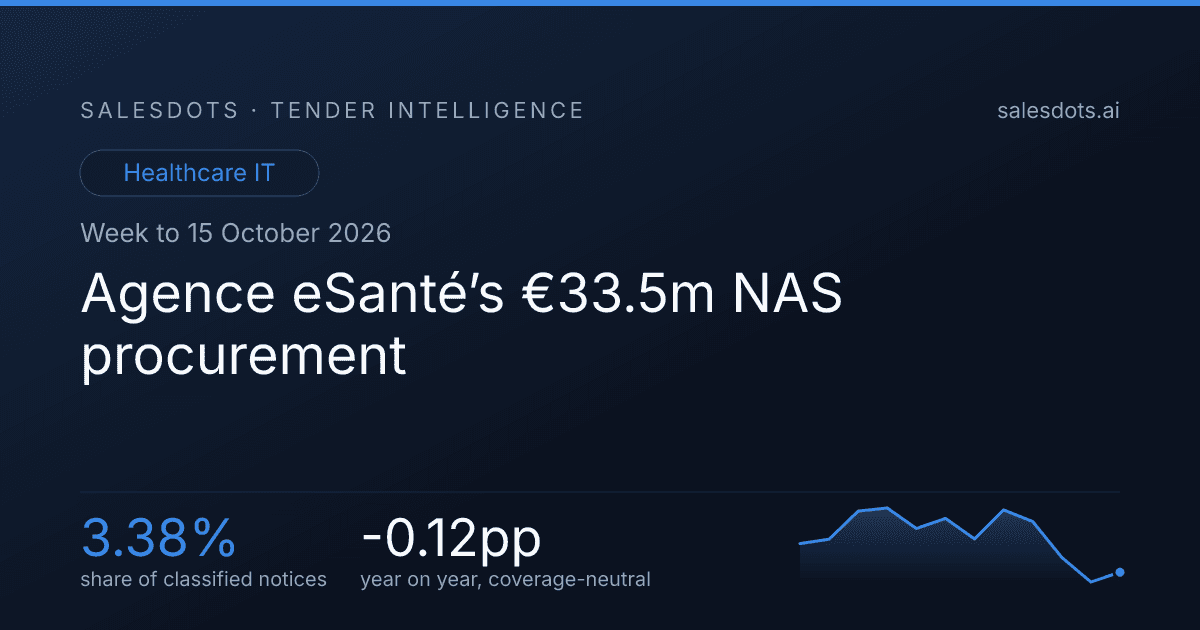
Agence eSanté has put a €33.5m Service National d’Authentification procurement into the market. The agency’s national platform supports secure health-data exchange, and its link to DigiSanté makes this a consequential route into Luxembourg’s health-data infrastructure. The call is listed ahead of the Health Service Executive’s €17m support, maintenance and development requirement for its existing Track and Trace software.
HSE also appears with a €2.2m national acute-stroke imagery analysis and decision-support solution. That pairing matters for suppliers: one buyer is sustaining an established operational platform while procuring a clinical decision tool, against the background of its One Health Record digital-health programme. This is not a generic software week; it is a week in which named national health bodies are buying authentication, maintenance and clinical intelligence.
Where this market is going
Healthcare IT now represents 3.38% of classified notices, a fall of 0.12 points on the coverage-neutral measure. Raw notice counts are 120 against 116 in the prior-year comparison, but that is not evidence of market growth because collection coverage changed. The monthly path is plainly lumpy: 3.41% in 2025-10, 3.55% in 2025-11, 4.44% in 2025-12 and 4.54% in 2026-01, followed by 3.89% in 2026-02 and 4.21% in 2026-03.
The pattern then moved from 3.56% in 2026-04 to 4.48% in 2026-05, 4.11% in 2026-06, 2.97% in 2026-07, 2.19% in 2026-08 and 2.5% in 2026-09. The current 3.38% is therefore a recovery from the late-summer trough, not a steady expansion. System implementation is the immediate demand signal, with 54 notices and a 347% movement against its 12-week average; support and maintenance has 35 notices and a 175% movement.
Healthcare IT: share of all classified public IT tenders
Share, not volume. Monthly, last 12 complete months.
Where the tenders were published
Notices by buyer country, 7 days to 2026-10-15.
How hard the competition is
Competition is uneven enough that country choice should alter the bid plan. Germany averages 3 bids, while Poland averages 1.5 and Czechia, Portugal, Spain and Lithuania each average 1. In Germany, assume rivals will clear the basic gate: technical differentiation, implementation credibility and quality evidence have to decide the pursuit. In Czechia, Portugal, Spain and Lithuania, the central constraint is more likely to be qualification and credible delivery capacity than price alone. Poland sits between those positions, but closer to a qualification-led than a crowded contest.
The measured average is 1.8 bids across 33 procurements, but the country contrast is more useful than that blended figure. The published pattern is 70% single-bid and the SME-bid share is 74%, making qualified sole responders and SME participation central to who secures the work. Portugal’s SPMS - Serviços Partilhados do Ministério da Saúde, E. P. E. appears with 6 tenders, while Czechia’s Ministerstvo zdravotnictví appears with 5: both are accounts where early qualification work is likely to matter more than a late pricing exercise.
How these contracts are awarded
Stated award criterion, for the tenders that declared one.
What is driving it
uKSC is the only regulation explicitly cited in these Healthcare IT tenders, appearing in 1 tender. Poland’s amended Cybersecurity Act requires covered entities to register, connect to S46, establish information-security management and incident-reporting arrangements, and meet associated security duties. Its citation momentum is 250 in the latest 30-day period and 250 in the preceding 30-day period. NIS2 records 3 and 4 respectively; DORA records 0 and 1; and CBAM records 0 and 1. For healthcare suppliers, uKSC points to both compliance work and procurement of the security capability needed to operate it.
The calendar also places the Solvency II Review transposition deadline on 2027-01-29 and application on 2027-01-30, while Bank Account Registries and BARIS apply from 2027-07-10. Those are financial-sector compliance deadlines rather than a Healthcare IT demand signal in this dataset, but they reinforce the distinction: regulatory references should be qualified as compliance-led until a buyer names the operational product or service required.
Regulations named in live tenders
Tenders citing each framework, last 30 days.
The calendar ahead
| Date | Framework | Milestone | Where |
|---|---|---|---|
| 2027-01-29 | Solvency II Review (Directive 2025/2) | transposition deadline | EU |
| 2027-01-30 | Solvency II Review (Directive 2025/2) | applies from | EU |
| 2027-07-10 | Bank Account Registries + BARIS (AMLD6 2024/1640 art. 16) | applies from | EU |
| 2027-07-10 | EU AML Package (AMLR 2024/1624 + AMLA 2024/1620) | applies from | EU |
What shifted this week
Demand by type of work, against its own 12-week average
Percentage difference from the same vertical’s recent baseline.
Whose technology is being named
The strongest named-vendor signals are upward, although the payload does not provide vendor delta percentages. Asseco appears in 4 notices against a 12-week average of 1.5; Philips appears in 3 against 0.8; and Microsoft appears in 2 against 1.1. RaySearch has 1 notice against 0.3 and HP Inc has 1 against 0.1. Infinitt, Nexus, Amazon Web Services, Simple ERP and Citrix each have 1 notice, with a 12-week average of 0 for Infinitt, Nexus, Amazon Web Services, Simple ERP and Citrix. Delta values are not supplied for any of these vendors, so the data does not support a claim that a named supplier is being displaced.
The fall is instead visible in offer types: managed services has 3 notices and a 16% decline, while custom development has 22 notices and a 26% decline. That makes the implementation and maintenance surge an opening, not proof of a particular vendor’s win rate. No named vendor is explicitly linked in the payload to Agence eSanté’s NAS tender, HSE’s Track and Trace requirement or the HSE stroke-imagery tender, so bidders should not treat those calls as identified incumbent contests without account-level checking.
Vendors named in this window’s tenders
Notices naming each vendor, with movement against the same vertical’s 12-week average.
Who is buying repeatedly
| Tenders | Buyer | Country | Example |
|---|---|---|---|
| 6 | SPMS - Serviços Partilhados do Ministério da Saúde, E. P. E. | PT | Portugal – Computer-related services – (DAG) Aquisição de serviços de gestão de projeto, análise, desenvolvime |
| 5 | Ministerstvo zdravotnictví | CZ | Czechia – IT services: consulting, software development, Internet and support – Služby EZ – Služby elektronick |
| 3 | SPMS, EPE - Serviços Partilhados do Ministério da Saúde, EPE | PT | Portugal – Computer equipment and supplies – [DAG] Aquisição de solução tecnológica, que permita o armazenamen |
| 3 | WIELKOPOLSKIE CENTRUM ONKOLOGII IM. MARII SKŁODOWSKIEJ-CURIE | PL | Poland – Miscellaneous software package and computer systems – Rozbudowa systemu HIS o moduł mApteka |
| 2 | Krankenfürsorgeanstalt der Bediensteten der Stadt Wien | AT | Austria – Software implementation services – Digitale Stationsplattform |
| 2 | Valsts sabiedrība ar ierobežotu atbildību "Bērnu klīniskā universitātes slimnīca" | LV | ICCA (IntelliSpace Critical Care and Anesthesia) sistēmas uzturēšana |
| 2 | Health Service Executive (HSE) | IE | Ireland – Clinical information system – HSE 25050 National Acute Stroke Imagery Analysis and Decision-Supporti |
| 2 | BITMARCK GmbH | DE | Germany – Software programming and consultancy services – TI-M ePA Client Weiterentwicklung PTV 1.1.2 |
An organisation running several tenders in one window is usually working through a programme rather than buying once.
The biggest tenders
The €71.6m disclosed-value total and €700,000 median cover only the 42 notices that published a value in EUR, not the full 120-notice market. Within that subset, Agence eSanté’s €33.5m NAS call leads; HSE follows with €17m for existing Track and Trace support, maintenance and development, alongside its €2.2m acute-stroke imagery analysis and decision-support call. Greece’s Οργανισμός Διασφάλισης της Ποιότητας στην Υγεία ΑΕ is buying integrated digital care for patients with neurodegenerative conditions at €6.5m. Lietuvos sveikatos mokslų universitetas (PV) has a €2.5m requirement for implementation, rental and maintenance of a healthcare-provider information system. The available research supports no more specific programme description for the Greek or Lithuanian buyer, so bid teams should treat the notice wording as the operative scope.
Values as published by the buyer, for the 42 of 120 tenders in this window that stated one in EUR.
Deadlines worth watching
Who won
Suppliers with the most awards this window
Awards published in the window, by named winner.
Sources consulted
Pages the writer read for context while drafting this column. The figures above come from the notices, not from these.
Watch whether the implementation surge turns into named-platform follow-ons from repeat health buyers, or whether low-bid markets remain dominated by suppliers that have already secured the required qualifications and delivery references.
Method
Built from 120 public procurement notices published between 2026-10-08 and 2026-10-15, classified into the Healthcare IT vertical. Every figure on this page is computed from those notices; the commentary is written around them. Sources: bzp, doe, ted, iub_lv, cvpis_lt, prozorro, sicap_ro. Tenders featured in earlier editions of this column are excluded from the named lists above.
Frequently Asked Questions
What is the current Healthcare IT notice share?
3.38%, a fall of 0.12 points.
How competitive are the measured Healthcare IT procurements?
1.8 average bids across 33 procurements, with 70% single-bid and 74% SME-bid share.
What value is disclosed in EUR notices?
€71.6m across 42 notices, with a €700,000 median.